I gave my AI perfect memory. That was a mistake.
My AI kept bringing back a vent I wanted gone. What human memory gets right about what to keep, where, and for how long, and what AI agents still miss.
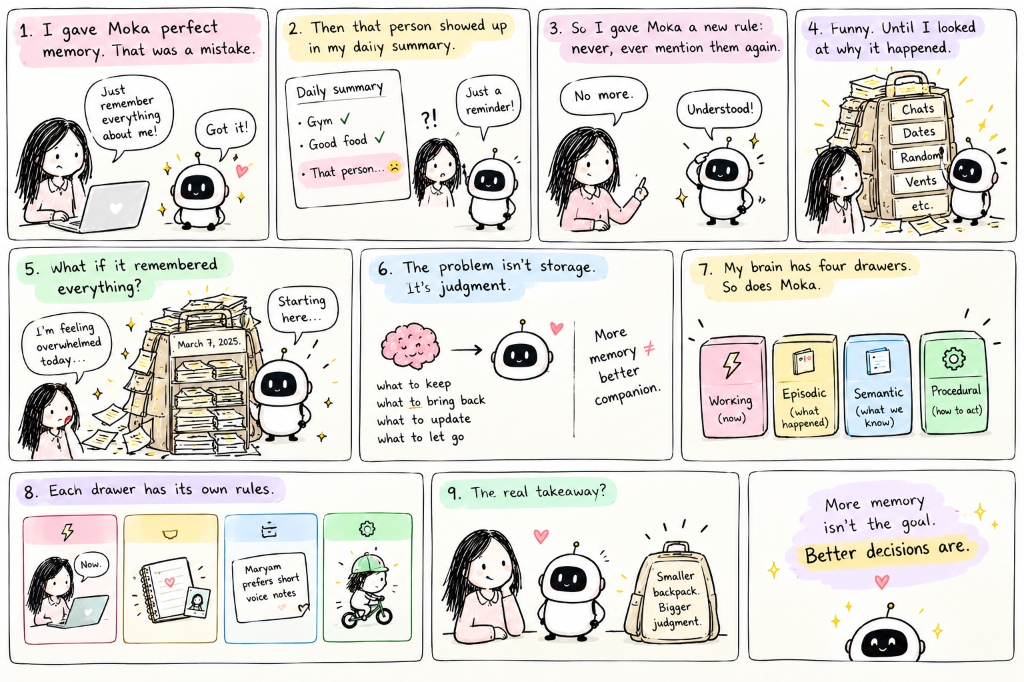
I vented to Moka, my little personal agent, about someone. Once.
Then that person showed up in my daily summary. Then in my weekly summary.
So I gave Moka a new rule: never, ever mention them again.
Funny. Until I looked at why it happened. Moka saved everything I said and treated all of it as equally important. A vent got the same weight as everything else.
What if it remembered everything?
I drew where this ends up. In the comic, I tell Moka to remember everything about me. It salutes and grows a backpack the size of a filing cabinet. Every chat, every passing comment, every date goes in.
Then I say: “I’m feeling overwhelmed today.” Moka opens thousands of folders and starts with March 7, 2025.
I wanted a friend. I got an archivist.
Let’s zoom out
More memory doesn’t make Moka a better companion.
Storage was never the hard part. The lifecycle is: what gets written, what gets pulled back for this moment, what gets updated, and what should quietly die.
My brain has four drawers. So does Moka.
Psychologists split human memory into a few types. A 2023 Princeton paper called CoALA took the same idea and applied it to AI agents. Same four drawers:
- Working memory. For me, it’s the phone number I hold in my head long enough to dial. My head only holds a handful of things at once, and that limit is what keeps me focused. For Moka, it’s what’s in the conversation right now. If Moka loads everything it knows about me into every reply, it loses the thing I’m actually asking.
- Episodic memory. For me, it’s what happened: last Tuesday’s bad meeting. I keep the story, not the transcript, and the sting of bad episodes fades faster than the good ones. Psychologists call this the fading affect bias. For Moka, it’s our past chats. Stories, not dumps, and they should age.
- Semantic memory. For me, it’s facts I just know: my friend is vegetarian. I didn’t learn that from one dinner. Facts get distilled from many episodes. For Moka, it’s things like “Maryam prefers short voice notes.” What’s still true, and only once it has shown up more than once.
- Procedural memory. For me, it’s riding a bike without thinking. Learned by repetition, shown in what I do, rarely said out loud. For Moka, it’s “when she asks for a draft, put it in Notion first.” It shapes how Moka acts, not what it tells me.
Here’s the part most AI memory skips. Each drawer keeps different things, for a different length of time. My brain doesn’t just decide whether to remember something. It decides what to keep, where to put it, and how long it lasts.
My vent was an episode, and episodes are supposed to fade. Moka turned it into a fact about my life, then a headline in my summary.
Having drawers isn’t enough. Each one needs its own rules for what gets written and what gets pulled back. And those rules are not fixed. I set them for my own life, and they keep changing as I learn what I actually need.
Three rules I start with
- Keep it or not. Decide at write time: keep, update, or skip. Not every message deserves a drawer.
- Which drawer. “What happened” goes in episodic. “What’s true” goes in semantic, and only after it has shown up more than once. A vent is something that happened, not a fact about my life.
- How long. Each drawer gets its own expiry. The desk clears after every conversation. Episodes fade. Facts stay until they stop being true.
Small desk
So I don’t need a bigger backpack. I need a small desk for what matters right now, four labeled drawers, and a trash can that actually gets used.
We spent years teaching AI to remember more. Now we have to teach it to decide what to keep, where, and for how long.
My friends never needed a “never mention them” rule. Moka shouldn’t either.